Wednesday, April 16, 2008

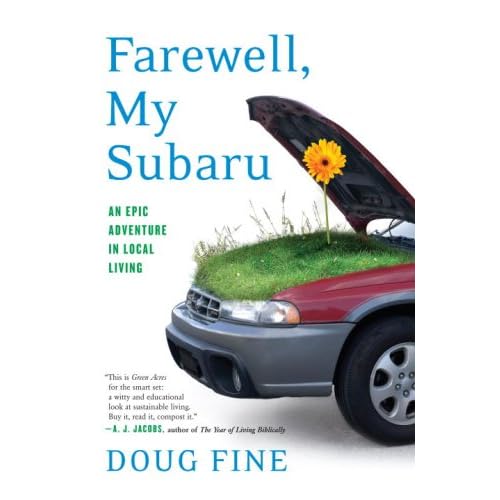
Farewell, My Subaru

This book was much needed in my life right now. A mix of wonderful writing, humor, and information that I found completely delightful. I read it in three days (and you all know I am a busy woman) and enjoyed 95% of it. The rest, I didn't understand... lol. His quips and comparisons (like naming his local coyote "Dick Cheney") were a highlight for sure. But the trials he went through were also very informative. I learned things I had never understood before. Including information about converting a huge diesel truck (he calls the ROAT or Ridiculously Oversized American Truck) to biofuel, the oily dog situations that ensue on one's property, and the complications that can arise from your ROAT always smelling like KFC, to the intricate measures one has to take to feed livestock newly bought during a devastating flood, his life on Funky Butte Ranch was enlightening, and highly entertaining.

Chapter Eleven "Modern Snake Charming" was particularly entertaining. If I say much more, I could ruin it... but if you know any New Mexican metaphysical types... you will laugh until you pee your pants.

It was a nice break to the doomsday thinking that sometimes engulfs people who have been studying sustainable living and climate change a bit too much. Like the author, Doug Fine, I believe that we are going to make it as a race. And I sure as hell would rather try than give up. So bring on the information about 'goat pimping', garden fence reinforcement that rivals most jails, rattle snake farming, and oily dogs. I am ready for this type of informative optimism.

Monday, April 14, 2008

Low carb becoming mandatory?

For the last two months, people who make bread and pizza have been constantly concerned with the price of wheat going up. For some of them, it is making their prices sky rocket to the point they are loosing business.

http://www.dailygazette.com/news/2008/feb/29/0229_wheat/

http://www.barternews.com/pdf/WheatShortage.pdf

Aside from people complaining about price, there is a real issue going on with a virus effecting the production of wheat.

Some say the 'shortage' is a myth, talking about the fact that it is really the falling American dollar that is causing the high price. This may be partially true. But with the wheat disease effecting millions in Asia and the Middle East, I think they are wrong. It isn't long before many people with be on mandatory low carbohydrate diets. And some may very well die from the lack.

Even my own local bakery, which we visited yesterday, had a sign up saying "Due to the rising wheat costs, some of our prices may have gone up. We are sorry for the inconveniences this may cause." Before long, bread could be the most expensive item we pick up at the grocery.

Tuesday, April 1, 2008

Find it hard to find coupons for organics?

Yes... me too. But this organic couponing guide article tells you how to get coupons to your favorites or be able to try new ones with out the bust to your pocket book. I have a friend (and fellow blogger) who has been very successful by writing to these companies and they have been sending her coupons for weeks now. :) What a fun, new way to see new organics, and be able to try new things!
I just sent off for a couple coupon books. I'll let you know how it goes.

To answer another question...

I need some more information on these 'Grassy Green Health Food Drinks'.

Is it this? Or this?

Reviewing the nutrition facts on the label, it seems that it is just ground up things that everyone should be eating anyway. lol... Minus some for some people, and minus others for other people. But honestly, every one should have at least one large serving of green leafy veggies... Organic wheat grass, organic barley grass, organic alfalfa, organic spirulina, organic spinach, organic broccoli, organic chlorella are the ones ground up and added into this "super" powder. Then they added ground up dried veggies that contain large amounts of antioxidants... Organic acai, organic maca, organic carrot, organic beet, raspberry, organic rose hips, pineapple, green tea, acerola cherry. Many of these also double as huge Vit C boosters. There are a few things I don't recognise in this blend. 'Maca' for example. Don't know what it is... so I will look it up. But from the over view of ingredients... it seems like just taking veggies, in powder form. Making them more concentrated. Which may not be the best way to get them, but it can't be the worst. ;)

I myself use a protein powder and some tablets of vit D in the winter time dosed into my smoothies in the morning (which have frozen organic bananas, strawberries or blueberries I picked last summer, maple syrup (you saw my undying love of that stuff), apple juice (the real stuff), and brewers yeast. It helps me keep through the long, cold, wet winters of the Pacific NW without modifying my low meat diet much... so I am not one to jump on the haters bandwagon. But at the same time, I am guessing that drinking these drinks does not substitute eating broccoli, or spinach in it's real and raw (and right out of your neighbors farm Field or your home garden) form. But then again... it is better than not eating them at all.

The main trouble with these super foods is usually in the pocket book, not the body.

Thursday, March 27, 2008

Did you know?

... tha maple syrup has more calcium than milk by volume and more potassium than bananas by weight? About 21 mg per tbsp of calcium! It is also terribly high in potassium (35 mg/tbsp).

This is where money outweighs facts when it comes to food marketing. They say that milk does your body good, but in truth, over consumption of milk causes all sorts of problems, and many shouldn't drink the stuff after the age of 4 years old at all! (Between 30 and 50 million Americans are lactose intolerant.)

Amazing what the media can put into our heads that make us put things into our bodies.

Monday, March 24, 2008

Country Capitan Chicken

This is a recipe that we loved from Kitchen Muse. It is a southern flare dish, with a bit of curry in it that brings out the flavor of everything. It is very nice over brown rice, or couscous. I always side it with a green salad, but you can honestly side it with any veggie dish, or make it a one pot meal by adding in 1 1/2 cups of couscous right into the pot! (We have done this too... it was a hit, but Don likes to pour his sauce over his starch).

Country Capitan Chicken
(with happy Val modifications)

4 Tbs butter
1/2 diced onion
1 diced carrot
1 diced bell pepper (color doesn't matter, but green works best)
6 cloves garlic (minced)

~~~~
3 lbs chicken peices (I like theighs)
2 Tbs olive oil
1/2 c flour
salt and pepper to taste

~~~~
2 cups diced tomatoes
2 cups chicken broth
3 tea curry powder
1/4 c slivered almonds
1/4 cup golden raisins

Melt butter in a large skillet. The skillet should be large ebough to cook the chicken in one layer. Add the onion, carrot, pepper, and garlic and cook until tender. Transfer to a bowl.

Mix flour and salt and pepper in a large bowl. Roll chicken peices in the flour mixture. Put oil into the skillet you just pulled the veggies from, and add the chicken, in one layer, turning until well brown on both sides.

Add veggies back in, along with tomatoes, stock and curry, mixing well. Stir in raisins and almonds. Simmer for about 10 minutes or until all chicken is cook through well.

Serve over couscous or brown rice.

It is very good!

Notice the new bowl plates. :) I love them. I am trying to get a eclectic set, but this set will be my salad plate/bowls, and my cereal bowls. The plates will come from somewhere else, and I don't need mugs (just ask my husband). I have been waiting for new dishes for about two years, and have been sitting on the money to get them for two months. I was ready for the perfect set to fall in my lap. And they did... while I was looking for Easter basket stuff for the kids.

Sunday, March 23, 2008

Wonderful Interviews

I really have to admit, I love this guy. He speaks everything I have thought for years, and has the studies and backings behind it to explain why...

http://cookingupastory.com/food-news-michael-pollan-in-defense-of-food/

There are at least 4 interviews here. One is from a farmer from Portland OR with a egg coop that I found yesterday, and it is here as well, and then the interview with Micheal Pollen that is just fasinating. Enjoy!

Wednesday, March 19, 2008

Big Farms vs Small Farms

Big Farming VS Little Farming

There are a LOT of ideas in these areas coming to light lately. In Omnivore's Dilemma, Micheal Pollen talks about this a bunch. His stance is that big farms are pretty necessary. We wouldn't have populated places where there isn't farm land without them. Think; people who live in Phoenix, AZ. The plant and animal bio-diversity there is severely limited by the lack of water and the lack of soil. People there are constantly shipping in foods just to survive. Without the large farms, people couldn't live in parts of our country that are heavily populated... but what about the impact?

The biggest impact of huge farms is Mono Cropping. Mono Cropping, in a nutshell, is planting the same thing, on the same land, over and over and over again. Thus having to put in nutrients that the soil lacks each year by artificial means to keep the crop that has depleted the soil of those same nutrients, growing there. 90% of the time, they do this with chemicals. Many of these chemicals are leached into the water table beneath these huge farms because the soil is barren and dry for the part of the year that the crops are NOT producing there. There is no reason to plant cover crops (which would replace some of these nutrients) with the chemicals so readily available, and there is no reason to crop rotate if you know that whatever your soil is lacking, you can just add chemical #1 from this box, and chemical #2 from this box and call it good. It is cheaper, faster, and takes MUCH less work.

The largest mono crops in this country are soybeans and corn. Usually not even grown for human consumption, but for cattle and livestock feed. But that is another post all together.

Every single gardening book I have (not just the ones that are for 'organic' or 'beyond organic' gardening) recommends crop rotation and cover crops if you have a large part of unused land. These things are vital to keeping the soil healthy. They bring back nutrients, and if you are careful, can even yield you another full crop! Yet, many (I dare say 'most') large farms have stopped doing this. Trucking in manure and planting legumes to overwinter seems out of the question on a large scale... but for the back yard gardener it is essential.


Big Organics VS Big "Conventional"

Using the word "conventional" here annoys me. The conventional way of growing has only been 'conventional' for less than 75 years. When talking about the history of farming, that doesn't seem to be long enough to set it as the "conventional" methods. But I digress....

Big organics are forced (and most willingly) to be more sustainable than their conventional counterparts. They use animal manure (usually organic as well) to supply the nutrients that their crops have used up. Some even still use cover crops for their needs as well, making them as efficient as many smaller organic farms (where it is the norm to do both of these things). So when asked if big organic is better than big conventional, the answer is a resounding YES! The more big organic companies are supported, the few chemicals are put into our soil and the more soil is used sustainably. But I say that with a bit of hesitation because big organic still is monocropping. Many large organic companies have one or two crops. This inhibits the biodiversity of an area, and that, as much as we can see now, is not the best for the environment.

Here is something I picked up from Wikipedia on the topic:

Proponents of organic farming say that "conventional" farming is unsustainable, because it relies on artificial inputs (synthetic fertilizers and other chemicals, machinery, etc.) that ultimately requires energy in the form of fossil fuels, and because the land is degraded through soil erosion, salinization, and other processes that eventually render the soil infertile. Many claim that without cheap fossil fuels and government subsidies, conventional agriculture would not be possible, and that despite technological advancements, there will eventually be an agricultural crisis as a result of depleted soil. The cultivation of monocultures, many acres planted with the same crop year after year, increases susceptibility to pests and diseases and depletes the soil, while eliminating most native flora and fauna.


In contrast, organic farming often utilizes
intercropping, crop rotation, fallow periods, and integrated pest management to promote biodiversity and preserve the health of the soil while minimizing the risk of diseases. The main goal of organic farming is sustainability, so organic farms seek to minimize dependence on outside resources and be self-sufficient.


Small Farms

You would not make it on a small farm with only one crop. Not unless you had a full time job to go with it. Being small, you are forced to find a niche in the food market so you don't get bumped out by the companies that can do things twice as cheap as you (and are usually 20 times as big). This is why most small farms you see now are certified (or becoming certified) organic. That is their niche. They can charge what they need, the supply line is shorter so the shipping doesn't cost quite as much (some customers will even come to you!), and they can raise a huge variety of crops, ensuring that when you stop by a farm stand, there will be something that catches you eye, and you will spend some money. Plus, if they loose one crop, it isn't their whole years livelihood. The small farms I have been to and worked with, all have been organic, so I couldn't tell you much about the small conventional farms. I have never seen one that was successful.

A few things have been true in all of the smaller farms I have seen. First off, they are organic. Like stated above. Secondly, they are family based. They have a few seasonal hands that come in here and there for planting and for larger harvests, but mostly, it is a couple, or a couple with extended family that is doing most of the work. Thirdly, their crops are very diverse. Peas to harvest in May, corn and new potatoes to harvest in July, and pumpkins to harvest in October. And lastly, they are working mainly for the local market. I have heard of being part of a cooperative of farms, such as Organic Valley farms is for dairy products, which get their products shipped all over the country, but for the most part, if you are a small farm, you do most of your work (planting, to harvest, to marketing, shipping, and sales) by yourself. So you don't tend to travel as far.

For me these factors mean two things. I like the idea of supporting families. Individuals. Not the guys at the very top of a big business organic food chain, but the actual people growing my food. I like that idea. Also, I appreciate that the food was picked maybe days before. Not weeks, but days. It stands to reason that they are picked much closer to peak ripeness as their conventional, big business counterparts because they don't have to be shipped from 2000 miles away to get to me. This could (I am not sure on the subject and there are many arguments for and against) mean that my food has been able to extract more nutrients from the soil in which it stayed for the entire period of time Mother Nature intended... making it far more nutritious than the ones that were picked weeks ahead of that natural schedule meant to be shipped from farther away than I go on my average vacation.
Monday, March 17, 2008

Good article about nutrition, taste, local, and organics

This article brings up and helps clarify some really wonderful questions about local foods, farmers markets, and organics 'at all cost'.

Eating Better Than Organic


I bet you, that man from the "liberal Washington group that supports strong organic standards" is currently living less than an hour from me. I should look him up.

Thursday, March 13, 2008

Animal, Vegetable, Miracle


I loved reading this book. Basically a fundamental story of one families story of local living. Kingsolver's plucky humor and realism was wonderful. She and her family had a go-getter attitude that I believe fueled many of their well planned dreams come reality. Again, it took years worth of planning to create this dream of local living. But she says many times, it is the small things that count. The asking questions that no one else asks, doing tasks like making your own cheese, and selling your extra eggs to neighbors... the caring about things that others dare not care about. And in the end, she writes about a very satisfying life, with no level of deprivation, on a mostly local diet. And in the process, she becomes part of a tight knit community as well.
It was a wonderfully inspiring read, and, aside from the intimate interludes into turkey sex, it had wonderfully digestible and easily do-able information.

Reviews, recipes, and many more joyous pictures can be found at their website:


Books on families or individuals going local are popping up for all over the globe and I hope they continue. It is wonderful to be able to read all of these books and glean what I can pull into my own personal life. Setting goals for a more local existence and getting off 'the oil' is a huge part of the environmentalist movement now-a-days and being able to take a bit from Pollan, a bit from Kingsolver, a bit from Cockburn, and a bit from Fine... well, I have a working plan in my head that evolves each time I crack a page in one of these library borrowed legacies into local living.