Showing posts with label Recommended Reading. Show all posts

Thursday, September 3, 2009

Apple Season by Joyce Sutphen


The kitchen is sweet with the smell of apples, big yellow pie apples, light in the hand, their skins freckled, the stems knobby and thick with bark, as if the tree could not bear to let the apple go.
Baskets of apples circle the back door,
fill the porch, cover the kitchen table.

My mother and my grandmother are
running the apple brigade. My mother,
always better with machines, is standing at the apple peeler; my grandmother, more at home with a paring knife, faces her across the breadboard.
My mother takes an apple in her hand,

She pushes it neatly onto the sharp
prong and turns the handle that turns
the apple that swivels the blade pressed tight against the apple's side and peels the skin away in long curling strips that twist and fall to a bucket on the floor.
The apples, coming off the peeler,

Are winding staircases, little accordions, slinky toys, jack-in-the-box fruit, until my grandmother's paring knife goes slicing through the rings and they become apple pies, apple cakes, apple crisp. Soon they will be married to butter and live with cinnamon and sugar, happily ever after.
This was sent to me from my Aunt Pat. Her SIL sent this note along with it, I couldn't help but include the note here:
Hi: I loved the apple poem. Thanks. We had an apple tree in our back yard when we lived in Magnolia. It had three different apples - King, Golden Delicious and Winesap. It bore prodigiously. I made sauce, pies, tarts, and Waldorf salads. This was such a treat for a Florida Cracker, who usually had a singhle apple or two per year. I always approved the devil's choice in tempting Adam. An orange or a banana wouldn't have done the trick. love Dot
signature

Friday, April 10, 2009

An extract from the book Seasonal Food by Paul Waddington

Introduction

Life in Britain was once intimately entwined with the seasons. Our survival depended on a wealth of skills we developed to take advantage of the growing seasons and to deal with the barren winter. We learned when to plant and harvest to ensure fresh food was available for as long as possible. We knew exactly when wild foods were ready for the taking. And we learned to dry, salt, smoke, preserve and store food to keep us going through the lean times, or to take advantage of abundance. Our year turned to a cycle that was driven by the seasons, with the last autumn harvests heralding the end of the old year and the beginning of the new.

For many of us today, technology has reduced the seasons to little more than an aesthetic distraction. Heating and air-conditioning keep us comfortable all year round. Refrigeration, high-technology storage and a globalized food market mean that we can eat whatever we want, whenever we want. The year follows very different rhythms: the school year, the tax year, the financial year.

As a result, what awareness we have of food's seasons is diminishing rapidly. It has arguably been on the wane for hundreds of years, since a series of land enclosures starting in the 1500s began to reduce the amount of common land on which small farmers and labourers could grow food and raise livestock for themselves. By the late eighteenth century, when enclosures accelerated, many were forced off the land and into towns and cities, where, according to food historian Colin Spencer: "...under the slavery of long hours and pittance wages, their diet declined to bread, jam, tea and sugar." While we might think that junk food, far removed from nature's cycles, is a relatively recent phenomenon, it has in fact been a part of British life for hundreds of years.

As the first people to industrialize, Britons were the first to lose our connection with the land and the seasons. We regained it -- albeit briefly, and under duress -- in the Second World War, when the 'dig for victory' campaign had the whole nation growing its own food and in better health than at any other time in the twentieth century. After the war, though, the combination of agricultural subsidy and chemical farming severed this connection anew, and brought us to where we are today: a world of cheap, year-round abundance.

So should we care about the relationship between food and the seasons when it is no longer a matter of life and death; when we (in Britain at least) can eat what we want, when we want?

I believe we should. For a start, there's the simple fact that food tastes better in season. From spring lamb to asparagus, from apples to wild salmon, fresh, local produce is better to eat than food that has been raised artificially, or that has travelled halfway around the world in a controlled-atmosphere container. There are straightforward reasons for this. Take tomatoes. They like to grow in rich, well-composted soil and need good strong sun to ripen properly. The flavour of a good tomato is a result of the subtle interplay between nutritious soil and sunlight. So it should come as no surprise that 'fresh' tomatoes, planted in an artificial substrate and grown out of season in an air-conditioned greenhouse, taste of nothing much at all. Or take intensively farmed salmon, also available all year round. Fooled into growing by artificial light, drenched in chemicals, drugged up to the eyeballs and crammed into pens at densities of up to 20 kg per cubic metre, they are not in good shape when they reach the supermarket. Wild fish, on the other hand, caught in season, have reached a prime condition that results from a natural life cycle and are an infinitely superior product.

Of course we can get many foods all year round. But it's a treat and a privilege to eat them in season, because for much of the year, many foods are far from being at their best.

Then there's the question of how sustainable our approach to food production and consumption is. Our 'year-round abundance' has carried a heavy price. The problems of industrial agriculture -- from unhappy salmon to battery hens to pesticide-soaked vegetables -- are well documented and have provoked a surge in the sales of organic produce. This is to the good, because apart from giving us foods free from agrochemicals whose deleterious effects are thought to range from poorer child health to male infertility, organic production has many benefits. It promotes biodiversity and soil quality; it reduces the pollution of waterways and land. And most of the time it gives us food that is healthier, richer in nutrients and tastier.

But adherence to organic standards alone is not necessarily a sustainable way for us to consume food; nor does it guarantee a superior product. Flying in organic spring onions from Mexico and collecting them by car from a supermarket create 300 times more CO2 emissions than if they were grown locally and delivered by an organic box scheme. And they don't taste as good, either.
In a world where man-made climate change is becoming an urgent issue, what we eat is more than just a matter of taste. Buying in season encourages us to buy locally, whether from the farmers' market in town or the specialist sheep farmer who sells direct. Supermarkets may pride themselves on an ever-growing range of organic produce, but if a kilo of apples has made the flight from New Zealand in March, are they really going to taste as good as a well-stored late British variety? And if you accept that human activity contributes to climate change, is this worth the kilo of CO2 they will produce, compared to the 50g if the same kilo were bought locally? Despite the fact that we can grow perhaps the best apples in the world, Britain has lost 60 per cent of its apple orchards since 1970, thanks in part to bureaucratic madness that paid growers to dig them up. Buying locally and in season encourages local producers, who are building a more sustainable food industry, contributing to a renaissance in British produce and cuisine and creating a better environment.

Most of all, though, eating with the seasons brings a rich variety into our lives. Where's the fun in eating the same things all year round? By being closely aware of what's in season, you get twelve months' worth of gastronomic treats, and satisfying answers to the perpetual question of what to buy and cook for yourself, family and friends. Today, the nearest thing to a seasonal gastronomic event in Britain is the annual consumption of an oversized fowl, accompanied by miniature cabbages, about both of whose qualities many have, at best, ambivalent feelings.

The seasons have much more to offer than this. British produce gives us a huge range of reasons to celebrate throughout the year. From the autumnal abundance of fruit, game and vegetables to the spring treats of lamb, fresh greens and mackerel, there is (almost) always something good, fresh and locally produced for us to enjoy

However, unless we are enthusiasts, farmers, or live close to rural tradition, many of us have only a vestigial awareness of what's in season when. Regaining this knowledge is not easy. Chefs and food professionals tend to keep it to themselves, occasionally giving away tempting titbits in their recipes: 'And now, of course, is the perfect time to eat lobster!' Why? How do they know this? How do we get to know this?

The purpose of this book is to put comprehensive knowledge of food's seasons back in the hands of people who buy food. It's not a recipe book -- there are plenty of those already. Seasonal Food is a guidebook to what's in season when and why in Britain so you can eat produce at its best, contribute to a renaissance in local production, and simply revel in the variety of the seasons.


-------- © Paul Waddington 2004

For his book and a bit more about it, his website is here.

Friday, March 20, 2009

Gardening book

Fresh from the Garden Cookbook

This is a book my best friend and I have been looking for for quite a while. We both absolutely LOVED Animal, Vegetable, Miracle by Barbra Kingsolver, but we also were frustrated that although all of her ideas were great, most were for the area she was in... which is far from here. Makes perfect sense as she was writing about local living. lol... But makes it difficult to implement for the beautiful Pacific NW. Well, this author, Ann Lovejoy, writes just for the Pacific NW... in fact, she lives up on an island about an hour from here and the area is her muse. Recipes, stories, different little tips on how to grow year round... and all for right here in my area. This is a book I will have to own.

I keep wanting to know if she is related to Sharon Lovejoy, my favorite children's garden author.

Saturday, October 11, 2008

Vegan Lunchbox

What a great book. Whether you are vegan, or going in that direction, or a total carnivore, this book is a great one to have on hand. Great recipes, good ideas, all sorts of good.
I personally recommend the Quick Peanut Sauce and the Black Rice Pudding.

One thing that I didn't like about the book. There was a lot of fake foods. For me, healthy eating isn't cutting out meat and dairy to add in soy meat, soy milk, and soy dairy. Those foods are just as processed as Kraft Dinner... and often just as bad for you. She doesn't put them in every meal. There were many recipes that I couldn't wait to try. And of course, these foods were included to make the child's meal more 'normal'. I totally understand the motivation. I, of course, don't send my children to school at all... so it is easy for me to say that it shouldn't matter while the children in my 'lunch room' all eat the exact same stuff and don't have to worry about fitting in at school. But the fact remains, I would rather find a humane way of eating chicken nuggets than getting nugget type foods made from soy products.

My favorite section was in the front where they had she put down several menus for all different types of lunch packers. That was brilliant. There is a bit for those of us who pack lunches the night before, a section for those of us who are early risers, and a section of quick and easy for those of us who like to have things on hand and don't think about it till morning. Great idea! I think more cookbooks should learn from her organizational ways.

I can't wait to try her Savory Autumn Leaf Pies. They sounds so good...

Wednesday, September 10, 2008

In Defence of Food by Micheal Pollan

I am becoming a die hard Michael Pollan fan. He is a wonderful writer (as most journalists are), but the information he gives answers SO many questions!

In the book "In Defense of Food" he attaches on to something he only touched on in "The Omnivore's Dilemma"... What to actually eat.

Oh yes, you can look at a food pyramid or an FDA guideline, based on sketchy facts, and supported by the industrial food industry. But when you know enough not to trust that 100%... where do you look to know what to eat?

This is the question he tackles. The rules he gives are not based on scientific evidence, but by the thousands of years that people have survived without the current eating disorders of the 'Western Diet' and the diseases that go along with it.

The 'rules' are fairly simple, once you understand what is meant by them:

"Eat food. Not too much. Mostly plants."

By "eat food", he means 'eat food that your great-great-grandmother would recognise'. There are not many industrial food products that would pass that test. Oatmeal? Corn meal? Yes. High fructose corn syrup? Go-gurt? Not so much.

"Not too much" is pretty self explanatory.

"Mostly plants" is the rule that is backed up by literally hundreds of years of meat being a side dish, or condiment instead of the main course and how our health has deteriorated from meat pushing the veggies right off our plates. This part also talks about the way our food chain has moved from 'leaves to seeds' and how this has effected every bit of that food chain, from the health of our meat cattle, to the health of our hearts.

Notice how he didn't go into vitamins, or 'nutrients' in his rules? In fact, in the book, he goes into those scientific specifics in great detail.... but not to the expense of the rules. You don't need to know how much more vitamin C is in your gardens romaine lettuce than the lettuce shipped from a thousand miles away to benefit from eating it. Taking food rules out of mom's kitchen and into the laboratory did more harm than good.

All in all, it is a light, if a bit scientific, read that has answered all sorts of questions I had about our culture and what the years of scientific nutrition study have done to our food habits. And, as with most of his books, In Defense of Food brings to the forefront a need to think about food differently. Bringing it from a place for overindulgence and nutrient specifics, to a cultural artery, so to speak.... to a place where eating is a relationship that will last a healthy lifetime.

Thursday, May 15, 2008

Books to look into

I have a few book recommendations:

Emergency Food Storage and Survival Handbook by Peggy Dianne Layton

Encyclopedia for Country Living by the late Carla Emery

The Complete Tightwad Gazette by Amy Dycyzen. (Her last name sounds like 'decision')

These are three books that will really spell it out for you in very easy terms how to live as frugally as possible. Which is usually the best for the planet as well. :)

Wednesday, April 16, 2008

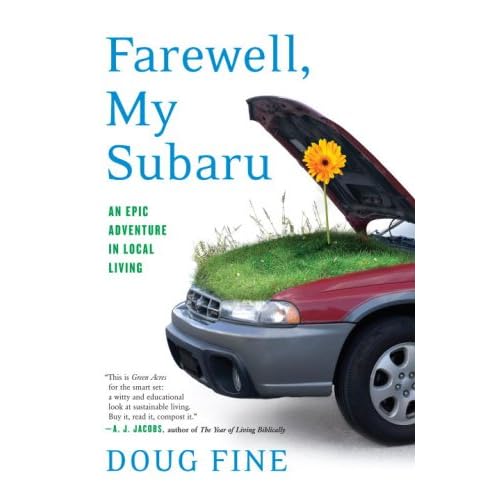
Farewell, My Subaru

This book was much needed in my life right now. A mix of wonderful writing, humor, and information that I found completely delightful. I read it in three days (and you all know I am a busy woman) and enjoyed 95% of it. The rest, I didn't understand... lol. His quips and comparisons (like naming his local coyote "Dick Cheney") were a highlight for sure. But the trials he went through were also very informative. I learned things I had never understood before. Including information about converting a huge diesel truck (he calls the ROAT or Ridiculously Oversized American Truck) to biofuel, the oily dog situations that ensue on one's property, and the complications that can arise from your ROAT always smelling like KFC, to the intricate measures one has to take to feed livestock newly bought during a devastating flood, his life on Funky Butte Ranch was enlightening, and highly entertaining.

Chapter Eleven "Modern Snake Charming" was particularly entertaining. If I say much more, I could ruin it... but if you know any New Mexican metaphysical types... you will laugh until you pee your pants.

It was a nice break to the doomsday thinking that sometimes engulfs people who have been studying sustainable living and climate change a bit too much. Like the author, Doug Fine, I believe that we are going to make it as a race. And I sure as hell would rather try than give up. So bring on the information about 'goat pimping', garden fence reinforcement that rivals most jails, rattle snake farming, and oily dogs. I am ready for this type of informative optimism.

Thursday, March 13, 2008

Animal, Vegetable, Miracle


I loved reading this book. Basically a fundamental story of one families story of local living. Kingsolver's plucky humor and realism was wonderful. She and her family had a go-getter attitude that I believe fueled many of their well planned dreams come reality. Again, it took years worth of planning to create this dream of local living. But she says many times, it is the small things that count. The asking questions that no one else asks, doing tasks like making your own cheese, and selling your extra eggs to neighbors... the caring about things that others dare not care about. And in the end, she writes about a very satisfying life, with no level of deprivation, on a mostly local diet. And in the process, she becomes part of a tight knit community as well.
It was a wonderfully inspiring read, and, aside from the intimate interludes into turkey sex, it had wonderfully digestible and easily do-able information.

Reviews, recipes, and many more joyous pictures can be found at their website:


Books on families or individuals going local are popping up for all over the globe and I hope they continue. It is wonderful to be able to read all of these books and glean what I can pull into my own personal life. Setting goals for a more local existence and getting off 'the oil' is a huge part of the environmentalist movement now-a-days and being able to take a bit from Pollan, a bit from Kingsolver, a bit from Cockburn, and a bit from Fine... well, I have a working plan in my head that evolves each time I crack a page in one of these library borrowed legacies into local living.

Saturday, March 1, 2008

Sustainable Living For Dummies


Lots of good information, too much for me to finish actually, but I got some wonderful ideas about how to build cloches and a few other great gardening tips, and over and over again it had off articles and tables and stats about how the world is changing and what we can do to help.

It is based in Australia (at least the one I got was) and I would love to see an American version of this, as it would be a much bigger help to me with all the resources lists and graphic tables. But it was easy to see that this type of book is going to help a lot of people get on a more sustainable path. It would have been great to have when I started this journey. I am no where near the where I want to be on a sustainable living path, but I had found most of the information in this book somewhere else first.

Monday, January 14, 2008

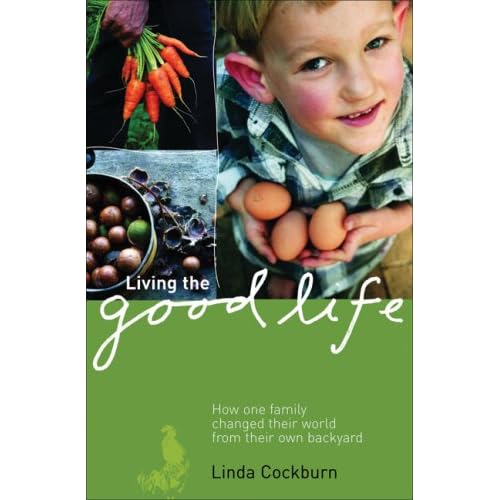
Living The Good Life

Yet another book about the ethics of food, (and this one also goes into the ethics of energy, water, and even waste disposal).

In this book, well it is really a diary of a families choice (mama, papa, and one spunky 6 year old boy) to go "money free" for 6 months.

They live in Australia, and so much of the culture, and even some of the language was different than something I would normally run into. Esp being from the wettest part of North America myself, drought often has no reach here. But there, it is becoming an every year problem. In the book you follow this family through their 6 self sustainable months through everything, from eating pumpkin (which they call all squash, from what I gathered... I would hate to think they were eating actual pumpkin all that time) every day for a while to what to feed Possum, their noisy and demanding milk goat.

The book was well written, although some of the language was clearly Aussie, and terribly interesting.

One of my complaints about the book is that I wish that she had gone in more depth about how they did their daily self sustainable things. She talks often about the 5000 kilo tanks she has outside, but does not ever show a picture of them, or where they are on her property. She talks at length about the composting toilet, but again, no picture, or how they put it in, etc. Some of those things would be helpful if they ever were to print a second addition to the book... to help others get used to the idea of that path.

It was nice to read that it took her three years to get ready to do the 6 month project (and in some cases much much longer prep was employed. Trev, her husband, built his own log cabin in the bush and it took 15 years.) So they had some tools. And it was nice to know that not just "everybody" could do it, but that this goal, of getting off the world oil tit, was a long term one... one that even the most prepared had to work at for a while before they could really employ.

The Omnivore's Dilemma


I have just finished the Omnivore's Dilemma. It is an intense book. It is one of those that you really want to read with a highlighter and a pen to write in the margins. lol... I am interested in reading whatever else Micheal Pollan puts out.

Man, the book is SO interesting. Really good information, put out in a way that is matter of fact, and not alarming in the slightest (unless of course, the content is alarming... I think I meant not "alarmist" in the sense that he doesn't go "This is TERRIBLE, look what THEY do....." KWIM?) He goes through four different meals, from as industrial as you can get to as 'natural' as you can get. McDonald's of course, came first. Then Whole Foods industrial organics. Then PolyFace Farms (a sustainable grass/meat farm). Then a meal he hunts, kills, grows or gathers himself.

He follows each one back to the very start of the food chain on which they were formed.

For McDonald's it was industrial grown corn to feed the chickens and the beef (cows are not made to eat corn). It is pretty amazing how much of the fast food is made from corn. You'd never know from eating it, but really, it is all corn fed meat, fried in corn oil, battered in corn starch, corn fats, and salts from corn, with a side of High Fructose Corn Syrup soda. I had some idea, but I just didn't realize how true his most famous quote is: "So that's us; processed corn, walking."

He follows that up with a nice stint on an industrial organic farm. Then moves on to PolyFace, then on to his own hunting/mushroom hunting/gardening experiences.

Fascinating. Just really really interesting stuff.

He makes a point of staying very objective through out the entire book, and sharing his opinions in a language that it is clear he is owning each and every one of them. He doesn't expect you to think the way he does... he just says what HE thinks. It is a nice refresher for those of us who have read "fad" diet books where there is only ONE way to do things (and here is why - and here is the science behind it is on page 452 - and here is why everything else is wrong on page 597... lol.).

The other two books I have right now promise to be lighter, and I am ready. Don said to me the other day that I really need to find something that I can read for pleasure. Something that doesn't give me more to work on and worry about at the end of the day. I said that is what NetFlix is for. lol... he wasn't convinced.

Wednesday, October 31, 2007

Wise Traditions

by Sally Fallon author of Nourishing Traditions

This article challanges the way we eat food today. Challanging that when 'they' say that half our diet should be made up of grains it doesn't mean processed grains, and that processed grains can actually be killing us and making our children more suseptable to disease.

I have never thought that cold cereal is good for you. But the main thing that has always held me back in buying it is price. Not nutrition. So when I read this, I was shocked to not only believe what she says, but understand that gut reaction that has told me that cereal isn't good for you. She doesn't use scare tactics... she uses plain facts. Some of which have been covered up by the billion dollar food market that keeps telling us these things are good for us.
Another thing that startled me was the way they put the fat back into milk. Now I am wondering if there is a way to get small farm milk from around here.

And orange juice... just make it yourself. Really.

A less scary article

Eric Schlosser, the author of Fast Food Nation, and one of my favorite non-alarmist, just good information authors, wrote this article about the food we consume:

Cheap Food Nation

A very good read and some great food for thought, with out the alarmist view of the inevitable death of us all. lol...

Wednesday, October 3, 2007

MaryJane's Ideabook, Cookbook, Lifebook


OMG... this book is one I will need to own. It is stuffed FULL of great ideas for the Farmgirl In All of Us as MaryJane says on the front cover. Everything from how to hem stitch to how to cook a one pot meal on a campfire, this book has it all. It even has jump rope songs from her childhood that will bring back memories from the youngest and oldest of us. Beautiful pictures are littered through this volume of her life. Truly an inspirational book! And one to own as well... because you will want to go back and use the ideas and recipes again and again.

Thursday, May 10, 2007

Extreme Simplicity


Great book... a million and one great ideas. Two things, however, were very clear... #1. These two live in South Cali... where it is hot and dry and you need to conserve water above all else. and #2. They don't have children.

Overall, I would give it a good rate of about 8 out of 10. Very effective, and they have some wonderful ideas that can really help. I loved their bit on pets, food, and gardening. The different ways they studied gardening (they basically have identified everything in their large SoCal yard and taken out things you cant eat (except the Castor Trees, which they said they just couldn't move from the spot... they were too rooted there, and it felt like an invasion) and added things that they can eat. Even a type of apple they found that grows in SoCal, but mostly citrus. And then they let the wild take over. They use compaion planting for their yearly annual veggie beds too... two ideas that I have been employing for a while and just love the way it makes my yard maintainence really easy. They talk about eating wild, pickling (the easiest and longest lasting canning way), and ways to cook with no power. They also talked about having chickens, pigs, ducks, and a bunch of other animals in a city setting. Along with water conservation, recycling, dumster diving, energy conservation, how to live with no power, solar pannels, and much much more. I loved reading it... but some of their suggestions made it very clear they had never lived with children (bring your dity clothes into the bathtub with you anyone? lol...)